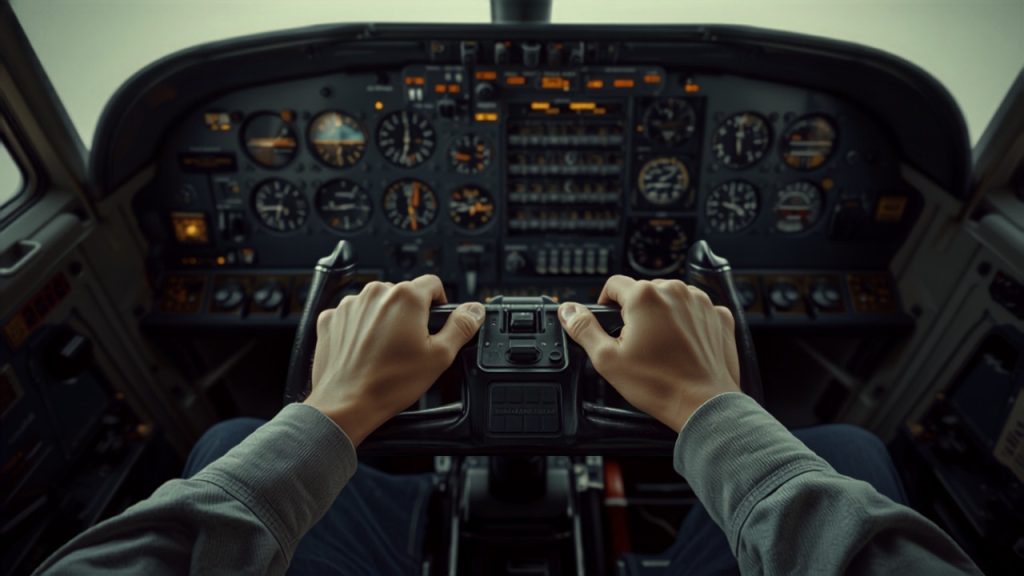
Ask any working airline pilot which part of their training actually shows up in daily flying, and a surprising number will point back to ground school rather than the hours logged in the air. The aircraft systems taught in ground school — engine, fuel, electrical, hydraulic, and the basics of avionics — form the mental model a pilot carries into every cockpit they ever sit in. It is not a subject you memorize for a written exam and then forget. It is the reason a pilot can look at a flickering annunciator light at ten thousand feet and know, within seconds, whether it is a nuisance or the start of a real problem.
The Engine: More Than Just “It Makes Thrust”
Most student pilots start their systems education with the powerplant, and for good reason — it is the system whose failure has the most immediate consequences. Ground school walks through how a piston engine converts fuel and air into rotary motion, why mixture leaning matters at altitude, and how something as simple as carburetor icing can quietly rob an engine of power on a humid day with no obvious warning signs. Students learn to read oil pressure and temperature gauges not as numbers on a dial but as a running conversation with the engine about its health.
This is also where pilots first encounter the idea of redundancy and failure tolerance. A dual magneto system exists because a single ignition failure should never be able to stop the engine outright. Understanding why that design choice was made changes how a pilot interprets a rough-running mag check during the pre-flight run-up — it stops being a checklist item and becomes a genuine safety decision.
Fuel Systems: Where “Sufficient Fuel” Becomes a Real Question
Fuel system knowledge in ground school goes well beyond knowing where the tanks are. Students study gravity-feed versus pump-fed systems, fuel selector logic, vapor lock, and contamination risks like water in the tanks. They also learn why fuel management errors — not fuel shortage itself — are behind a disproportionate number of engine-out incidents. A pilot who understands how fuel is drawn, filtered, and delivered is far less likely to mismanage a selector valve mid-flight or misjudge usable fuel on a longer cross-country leg.
Electrical Systems: The Nervous System of the Aircraft
Modern trainer aircraft, even relatively simple ones, depend on electrical power for far more than cabin lighting. Radios, navigation instruments, flap motors, and increasingly the primary flight displays themselves all draw from the same electrical bus. Ground school covers alternator and generator function, battery behavior under load, and what actually happens when a bus fails partway through a flight — which instruments stay alive, which go dark, and what backup sources exist. This is knowledge a pilot hopes never to need urgently, but when a generator light comes on in cruise, the difference between calm troubleshooting and confusion often comes down to whether this material was actually understood, not just passed.
Hydraulic Systems: Small Aircraft Now, Bigger Aircraft Later
Light trainers used in early CPL training may only use hydraulics for brakes, but the conceptual groundwork laid here matters enormously later. Understanding fluid pressure, reservoirs, and actuator behavior in a simple system builds the foundation for the far more complex hydraulic architecture found in the transport-category aircraft most cadets are ultimately training toward. Instructors at ground school often frame this section as an investment — the aircraft gets more complicated, but the underlying physics does not change.
Why Instructors Emphasize the Fundamentals Early
A student who genuinely understands why a hydraulic system loses pressure will diagnose a real fault faster than one who only memorized a symptom-response table. This is one of the clearer arguments for how a structured commercial pilot training program sequences ground subjects before advancing students into more complex aircraft type knowledge — the fundamentals have to be solid first.
Avionics Basics: Reading the Aircraft’s Own Story
Even at the private and commercial pilot level, avionics ground school introduces students to pitot-static instruments, gyroscopic instruments, transponders, and basic navigation systems. Students learn what can cause an altimeter to read incorrectly, why a blocked static port is dangerous precisely because it fails quietly, and how GPS-based navigation differs from older radio-based methods in both reliability and failure modes. This section rewards curiosity — pilots who ask “what happens if this fails” during ground school tend to be the ones who stay composed when it actually does.
Why This Knowledge Matters in the Cockpit, Not Just the Exam
It would be easy to treat aircraft systems as an exam hurdle — memorize the diagrams, pass Aircraft Technical/General, move on to flying. But systems knowledge is what separates a pilot who follows a checklist mechanically from one who understands why the checklist exists. When something behaves unexpectedly in flight, there is rarely time to look up a manual. The pilot’s internal model of how the aircraft works has to fill that gap instantly.
This is also why experienced instructors keep circling back to systems knowledge throughout flight training, not just during the classroom phase. A well-run flight training academy treats ground school and flight training as two halves of one continuous process rather than separate boxes to tick.
- Systems knowledge shortens the time it takes to correctly identify an in-flight abnormality.
- It builds the judgment needed to distinguish a genuine emergency from a manageable nuisance.
- It carries forward directly into type-rating training on larger, more complex aircraft.
- It gives pilots the vocabulary to communicate clearly with maintenance and air traffic control during an abnormal event.
Students who struggle with a particular system rarely need to muscle through it alone. Academies with strong student support services typically offer additional doubt-clearing sessions or peer study groups specifically because systems subjects are dense and benefit from repetition in different formats — diagrams, discussion, and hands-on component familiarization all reinforce each other.
Carrying It Forward
By the time a cadet finishes ground school, they should be able to explain not just what each system does but why it is built the way it is, and what its failure would actually look like from the cockpit. That kind of understanding does not expire once the exam is passed. It sits quietly in the background of every flight, and on the rare occasion something goes wrong, it is usually the only thing standing between a manageable situation and a genuine crisis.