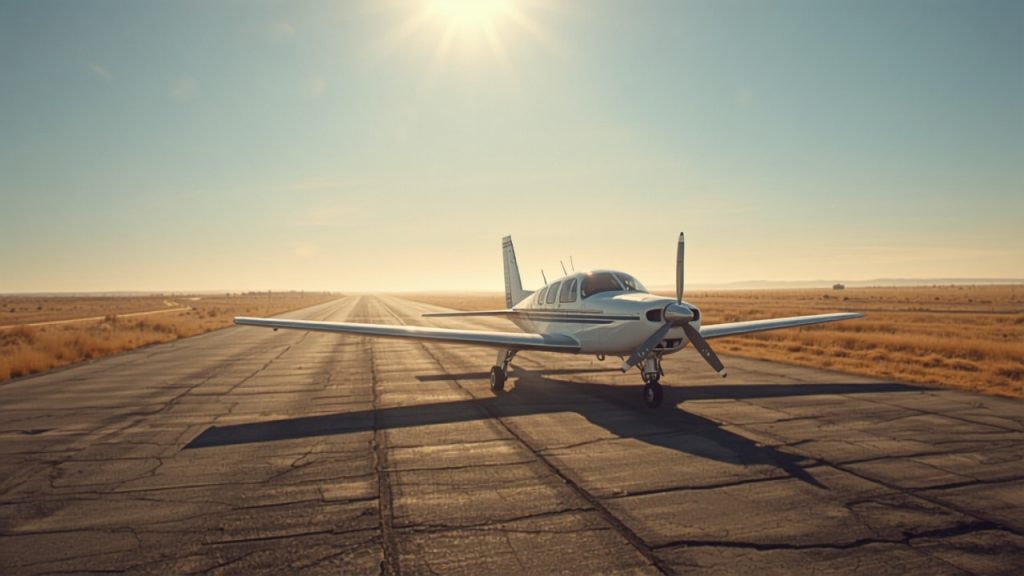
Ask any instructor what changes between a cool morning lesson and a sweltering afternoon one, and you will usually hear the same thing: the aeroplane feels lazier. It needs more ground before it lifts off and it climbs away more slowly. Nothing is broken. The air itself has changed.
This guide looks at the practical side of that idea, why a hot day or a high airfield asks for more runway, and what student pilots do about it. If you want the formal definition first, our post on density altitude and aircraft performance covers the theory. Here we stay with the runway and the habits that keep a takeoff comfortable.
Quick answer
Hot air is thinner than cool air, and so is air at a high airfield. Thinner air gives the wings less lift, the propeller less thrust and the engine less power. The aeroplane therefore needs a longer takeoff run, climbs more slowly and covers more ground on landing. Pilots plan extra margin on warm days.
Why does thin air mean a longer takeoff run?
An aeroplane lifts off when its wings produce enough lift, and lift depends on how many air molecules flow over them each second. In thinner air there are fewer molecules, so the aeroplane must move faster over the ground to make the same lift. A faster liftoff speed takes more runway to reach.
The engine adds to the problem. A piston engine breathes air, and less dense air means less oxygen in each cylinder, so power falls. The propeller also bites into thin air less firmly. The result is slower acceleration at exactly the time you need more of it. Our explainer on the four forces shows how lift, thrust, weight and drag all feed into this.
How much do heat and altitude really matter?
Both heat and height reduce air density, and they combine. A warm afternoon at a sea-level airfield can behave, in performance terms, like a much higher airfield on a cool morning. The exact numbers depend on the aeroplane, so students are taught to read the performance charts in the flight manual rather than rely on rules of thumb.
Humidity plays a smaller part but it is not zero, and a coastal city can be both warm and humid. Our post on how Chennai’s coastal location shapes training touches on how local conditions change a flying day.
| Condition | Effect on air | Effect on the aeroplane |
|---|---|---|
| Hotter air | Less dense | Longer takeoff run, slower climb |
| Higher airfield | Less dense | Less engine power and lift |
| More humid air | Slightly less dense | Small loss of performance |
| Cool, dry morning | Denser | Best takeoff and climb performance |
The table is a simple picture, not a calculation. Real figures always come from the approved manual for the exact aeroplane you fly.
Does a hot day affect landing too?
Yes, though in a different way. The aeroplane lands at the same indicated airspeed, but thinner air means a higher true speed over the ground. A higher ground speed makes the landing roll longer. Hot days also bring thermals and bumpy air in the circuit, which can make the approach harder to hold steady.
This is one reason instructors like early starts in warm months. It is also why the idea of a stable, well-judged final approach matters on every flight, whatever the weather.
How do student pilots plan for it step by step?
Planning for performance is a routine, not a special event. Your instructor will teach you a sequence like the one below, and you will repeat it until it becomes second nature.
- Check the airfield temperature and elevation in the weather report, using the approach in our METAR and TAF guide.
- Open the aeroplane’s approved flight manual and find the takeoff performance chart.
- Enter the temperature, elevation and weight, and read off the takeoff distance.
- Compare that distance with the runway length available, and add a generous margin.
- Include the aeroplane’s weight in your thinking, since a heavier load lengthens the run.
- Decide before you start rolling what you will do if the aeroplane is not accelerating as expected.
- Mention your calculation to your instructor and ask for a second opinion.
Doing this during the pre-flight preparation keeps the work calm and unhurried, rather than squeezed in at the runway threshold.
What warning signs show a takeoff is not going well?
The clearest sign is slow acceleration. If the aeroplane has not reached its expected speed by the point you planned, or the end of the runway is coming up faster than the numbers suggested, the correct and widely taught decision is to stop while there is still room. Rejecting a takeoff early is a normal, respected decision.
A weak climb after liftoff is the other sign. In that case you keep the aeroplane flying at the recommended climb speed, avoid steep turns close to the ground and follow the emergency procedures your instructor has taught. Training schools report that these decisions are discussed again and again in briefings, so that the right choice feels automatic.
What habits help on warm days?
Experienced pilots build small habits that add safety margin. They fly early when possible, they carry less weight when they can, and they choose the longest suitable runway. They also lean the engine as taught in the flight manual for the conditions, because a correctly set mixture helps the engine deliver the power it can.
Above all, they treat the performance numbers as a minimum standard, not a target. If the chart says the aeroplane can just make it, a careful pilot waits for cooler air or a lighter load.
Frequently asked questions
Why does a plane need a longer runway when it is hot?
Hot air is less dense, so the wings make less lift and the engine makes less power at the same speed. The aeroplane needs a higher ground speed to lift off and takes longer to reach it, which means more runway.
Is density altitude the same as the height of the airfield?
No. The airfield elevation is a fixed height above sea level. Density altitude is the height in the standard atmosphere that matches the actual air density, so it changes with temperature and pressure through the day.
Does humidity change takeoff performance?
Yes, slightly. Humid air is a little less dense than dry air at the same temperature, so performance falls a bit. Most of the effect on a warm day still comes from temperature and altitude.
Where do student pilots find the takeoff distance?
In the approved flight manual of the aeroplane they are flying. It has charts or tables that use temperature, elevation and weight. Your instructor will show you how to read them and what margin to add.
Can a pilot ever take off if the numbers look tight?
A careful pilot waits. Options include a lighter load, cooler air later or earlier in the day, or a longer runway. Your instructor will explain the margin the school expects and the right decision to make.
Where can you learn this in Chennai?
If you want to learn how performance planning works with an instructor beside you, talk to VeritasTech Pilot Academy, Ambattur, Chennai. The academy can explain how training is structured and what the first steps look like.