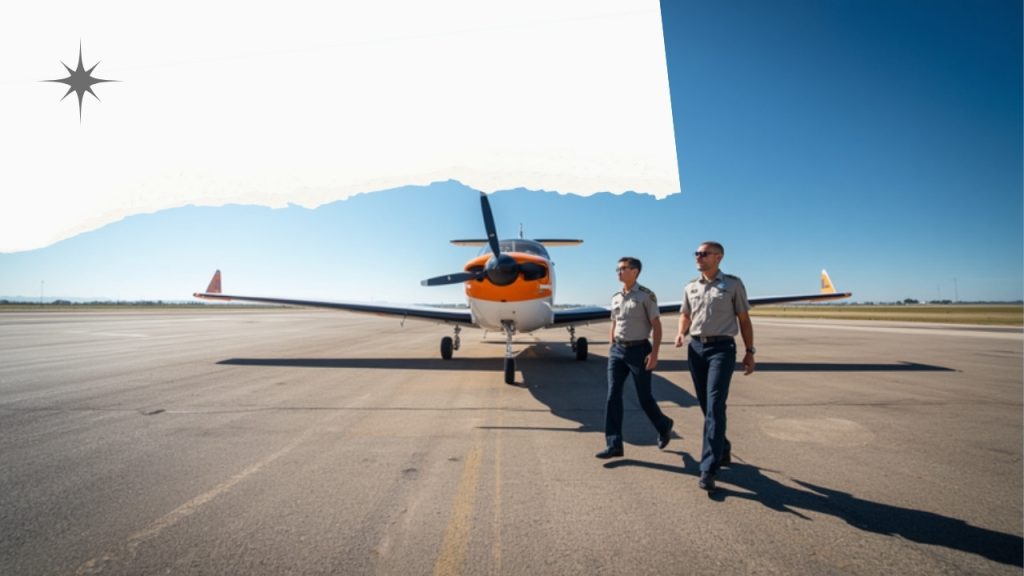
Ask any flight instructor who has trained pilots in more than one part of India, and Chennai tends to come up as a genuinely good place to build flying hours — not because of any single standout feature, but because of how several factors line up together. Understanding what makes Chennai a good location for flight training means looking past the obvious (it has an airport) and into the details that actually shape a student’s day-to-day flying experience: the airspace structure, the weather calendar, the coastline, and the broader aviation ecosystem sitting around the city.
Airspace That Rewards Careful Planning Without Overwhelming Beginners
Chennai International Airport (VOMM) sits within controlled airspace that handles a genuine mix of scheduled domestic and international traffic, military movements, and general aviation activity. For a student pilot, that’s actually a good thing. Training entirely inside quiet, uncontrolled airspace makes for an easy early solo, but it doesn’t prepare anyone for the radio discipline, sequencing, and situational awareness that commercial flying demands later on.
Chennai gives students exposure to real ATC communication and controlled-airspace procedures early, while the surrounding region also has smaller, less congested airfields where basic circuit work and early solo hours can happen without the pressure of a busy Class C or D environment. That combination — controlled complexity nearby, simpler airspace within reach — is harder to find in cities where the only training option is either a single overloaded international hub or nothing but sleepy grass strips.
A Weather Calendar That Actually Cooperates With Training Schedules
Weather is the single biggest variable in how quickly a student pilot accumulates flying hours, and this is where Chennai’s location on the southeastern coast works in its favor for most of the year. Unlike the west coast, which takes the brunt of the southwest monsoon from June through September, Chennai’s rainiest stretch is concentrated in the northeast monsoon, roughly October through December. For the rest of the year, the city sees long stretches of stable, largely clear skies with predictable diurnal patterns — a sea breeze that builds through the afternoon, generally good visibility, and comparatively few days lost entirely to low ceilings or widespread fog.
That’s not to say Chennai’s weather is effortless. Summers bring real heat, and the northeast monsoon period does require careful weather briefing and some flexibility in scheduling. But measured across a full training calendar, students lose fewer flying days here than in regions with longer, harder monsoon seasons or persistent winter fog, which matters a great deal when you’re trying to keep skills current and maintain a consistent training rhythm.
Coastal Geography as a Practical Training Asset
Being on the coast isn’t just a scenic detail. It gives instructors a natural, repeatable environment for teaching sea breeze effects, coastal visibility changes, and the way terrain and water interact to shape local weather — concepts that show up constantly in real-world flying but are hard to teach convincingly inland. Cross-country routes that run along or near the coastline also give students clean, reliable visual reference points for navigation practice, which builds confidence before moving on to longer, more complex cross-country legs.
The flat terrain around Chennai and the broader Tamil Nadu coastal belt also removes a layer of complexity that mountainous training environments introduce early on. That’s useful pedagogically — it lets early lessons focus on the fundamentals of aircraft handling and navigation without terrain-driven turbulence or density altitude complications clouding the picture. Those more advanced considerations get introduced later, once the basics are solid, rather than being forced on a student in week two.
Access to Both Controlled and Uncontrolled Airfields
Tamil Nadu’s aviation infrastructure includes a mix of airport categories within reasonable reach of Chennai, which gives training programs real flexibility in how they structure a syllabus. Circuit training and early solo work can happen at quieter fields, cross-country navigation exercises can route through varied airspace classes, and controlled-field operations can be introduced progressively rather than all at once. That range matters more than it might sound — a student who only ever trains at one type of airfield graduates with a narrower set of practical experiences than one who has had to adapt to different environments along the way.
A Regional Aviation Ecosystem That Extends Beyond the Runway
Chennai’s role as a major aviation hub for South India goes beyond passenger traffic. The city and its surrounding region host maintenance and engineering activity, cargo operations, and a growing base of aviation-related businesses, which means student pilots training here are immersed in an environment where aviation is a visible, active industry rather than something abstract. That exposure has real value — it’s easier to stay motivated through the demanding parts of training when you can see, on a daily basis, what the working end of the industry actually looks like.
This regional depth is part of why the flight training programs based here can offer students a well-rounded introduction to commercial aviation, not just stick-and-rudder skills in isolation. The instructors and staff, many of whom you can learn more about on the academy’s about us page, bring operational experience from this same regional ecosystem into the training environment, which shapes how the syllabus is taught day to day.
What This Means in Practice for a Student Pilot
Put together, these factors don’t make Chennai a training location with no drawbacks — no city has that. What they add up to is a location where a student is likely to fly more consistently across the year, get earlier exposure to real controlled-airspace procedures, train in an environment with genuinely useful coastal and navigational variety, and do all of that inside a region where the aviation industry is a tangible, everyday presence rather than something read about in a textbook.
If you’re evaluating locations for flight training and want a clearer sense of how a Chennai-based syllabus is structured around these regional advantages, the academy’s student support team can walk you through how weather planning, airfield access, and airspace exposure are actually built into the training calendar here. Those details tend to matter more in daily practice than they do on paper, and they’re worth understanding properly before you commit to a training base.